


Your franchise lead generation may not be failing because your ad budget is too small. It may be failing because the inquiries you already paid for are arriving in a sales process that responds too slowly, follows up too inconsistently, or loses momentum during candidate validation.
That is the uncomfortable diagnosis. More ad spend can increase activity, but it cannot repair a neglected CRM, an unclear sales cadence, or a team that treats “request more information” as the finish line instead of the starting point.
A Harvard Business Review speed-to-lead study found that companies that reached a lead within an hour were nearly seven times more likely to qualify it than those that waited longer, and roughly 60 times more likely than those that let a full day pass. The same study also noted that nearly a quarter of businesses never responded at all. In other words, your competition may not be winning with better advertising. They may simply be answering the phone.
Why Franchise Lead Generation Looks Broken When Follow-Up Is the Real Leak
Imagine directing a bright blue firehose into a bucket with three large holes:
- One hole is slow response time.
- One is inconsistent follow-up.
- One is poor CRM discipline.
Turning up the water pressure does not fix the bucket. It creates a bigger mess.
The same thing happens when a franchisor increases paid search, social advertising, portal placements, or retargeting without examining what happens after an inquiry arrives. Lead volume rises, the CRM looks busy, and the sales team reports that “the leads are bad.”
Sometimes the leads are bad. But before you blame lead quality, ask:
- How quickly did someone respond?
- How many meaningful touches did the prospect receive?
- Was the next step clearly assigned?
- Did the candidate receive useful information or only generic check-ins?
- Can you identify exactly where qualified candidates are going quiet?
If you cannot answer those questions, you do not yet have an advertising problem. You have a pipeline visibility problem.
For a broader look at the stages where franchise prospects disappear, read FranLift’s guide to why your franchise pipeline may be leaking.
What Happens After a Franchise Lead Generation Inquiry Arrives?
The most important part of franchise lead generation begins after the form is submitted. That is where intent either becomes a conversation or starts to decay.
Response time sets the tone
A candidate who requests information is often comparing multiple franchise opportunities. Their attention is active, but it is not exclusive. If your first response comes tomorrow, another brand may already be discussing territory, investment, and ownership goals with that same person.
A practical operating standard is:
- Automated confirmation within one to five minutes
- Human outreach within 60 minutes during business hours
- No inquiry left untouched for more than four hours
- Immediate task creation and ownership inside the CRM
Research summarized by FranConnect consistently points to speed-to-lead as a major factor in qualification and conversion. Automation can protect the first few minutes, but it cannot replace a thoughtful human conversation.

One call is not a follow-up strategy
A common process looks like this: a lead arrives, a salesperson calls once, leaves a voicemail, sends an email, and closes the task after receiving no reply.
That is not a cadence. It is a handoff to chance.
A stronger sequence may include eight to twelve touches across two to three weeks:
- Immediate email and text acknowledgment
- First call with a clear reason for connecting
- Follow-up message addressing the candidate’s likely questions
- Additional calls at varied times of day
- Educational content about investment, ownership structure, or territory
- A direct invitation to schedule a discovery conversation
- Longer-term nurture if the candidate is interested but not ready
Every touch should add value. “Just checking in” does not create momentum. A useful message might clarify the expected owner role, explain the next stage, or answer a question raised during the first conversation.
CRM discipline turns effort into a system
If your sales team tracks leads in inboxes, spreadsheets, personal notes, and memory, your process is already leaking.
A disciplined CRM should show:
- Lead source and campaign
- Time of inquiry
- Time of first automated and human response
- Every call, email, and text
- Current pipeline stage
- Next action and due date
- Reason for inactivity or disqualification
- Expected timing for the candidate’s decision
The objective is not to create administrative work. It is to make missed work visible.
A lead should never sit in the CRM without an owner, a current stage, and a next action. If it does, the system is reporting history instead of driving progress.
Why Good Candidates Go Quiet During Validation
Many franchisors assume a candidate is lost when they stop responding after an initial conversation. Often, the candidate is not rejecting the opportunity. They are trying to validate it.
This stage is where serious prospects examine:
- Whether the investment matches their liquidity
- Whether the model fits their desired level of involvement
- How the unit economics compare with alternatives
- Whether the territory is attractive
- What support looks like after signing
- Whether the leadership team feels credible
- Whether the franchise opportunity fits their personal goals
Validation is not a single call. It is a period of questions, research, conversations with existing franchisees, FDD review, and internal debate.
That is why strong follow-up must educate rather than pressure. If a candidate says, “I need to think about it,” the next step should not be an automated reminder three days later. It should be a relevant response:
- “What part of the model would you like to examine more closely?”
- “Would it help to review the owner responsibilities?”
- “Are you comparing investment levels, territories, or support structures?”
- “Would a conversation with an existing franchisee answer the questions you still have?”
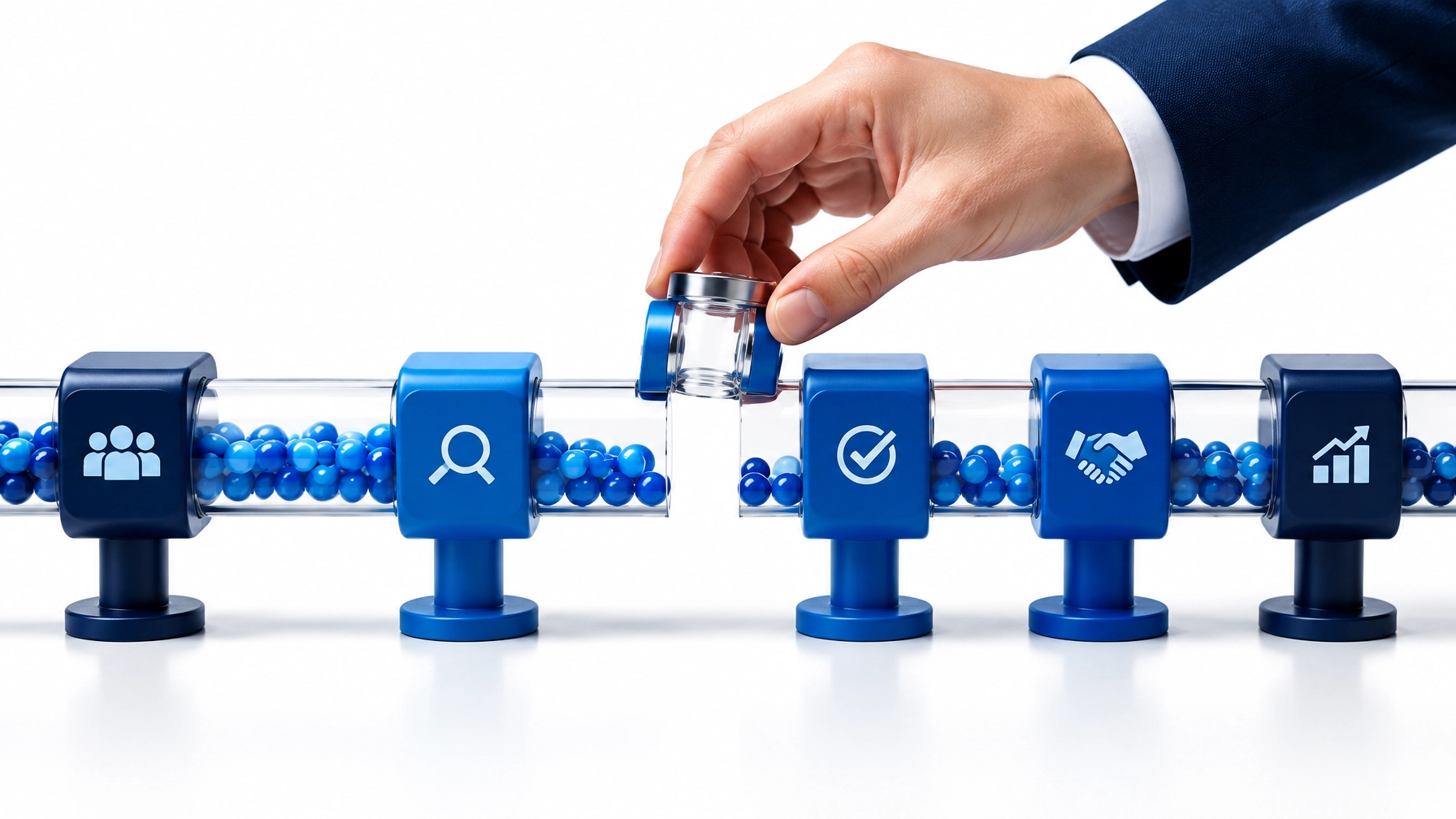
Consider a hypothetical brand that receives 50 inquiries in a month. Ten are clearly unqualified. Another 15 never receive a human response within the first day. Of the remaining 25, eight have an initial conversation but receive no structured follow-up. The brand may conclude that its advertising produced only poor leads.
The more accurate conclusion is that the brand had a follow-up problem at three different points: response, cadence, and validation.
Franchise Lead Generation Needs a Follow-Up Operating System
Improving results does not require guessing at a larger budget. Start by designing the operating system around the lead.
Establish stage definitions
Define what must happen before a candidate moves from inquiry to qualified lead, discovery call, application, FDD review, validation, and final decision.
Each stage should have:
- Entry criteria
- Required information
- A specific owner
- A defined next action
- An expected time frame
- A reason code for stalled or closed opportunities
This gives you a way to distinguish a marketing issue from a sales execution issue.
Measure the leaks that matter
Track more than cost per lead. Monitor:
- Average speed to first human contact
- Contact rate within 24 hours
- Number of touches per opportunity
- Qualified lead to discovery call ratio
- Discovery call to application ratio
- Application to agreement ratio
- Days spent in each stage
- Percentage of leads with no next action
The quality-versus-volume approach to franchise lead generation explains why cost per deal and candidate fit are more meaningful than raw inquiry counts. Those metrics become even more useful when your team can see exactly how follow-up affects each conversion point.
Separate automation from ownership
Automation is excellent for acknowledgment, reminders, educational sequences, and long-term nurture. It is not a substitute for judgment.
A candidate considering a six-figure investment needs a knowledgeable person who can listen, ask good questions, explain the model accurately, and identify whether the opportunity is genuinely appropriate.
The best process combines automated consistency with human accountability.
Best For: Choosing the Right Follow-Up Model
Best for lean brands: an internal owner with a documented process
A founder or internal team member can manage follow-up successfully when inquiry volume is modest and someone has protected time for franchise sales.
Considerations and trade-offs: This approach preserves control and may be cost-effective, but it can break down when operations, marketing, and franchise development compete for the same person’s attention.
Best for strategic planning: a traditional franchise consulting firm
A consulting firm can help with franchise readiness, market positioning, legal coordination, financial modeling, and high-level development strategy. A strong plan can prevent expensive mistakes.
Considerations and trade-offs: A strategy report does not make calls, manage daily tasks, or advance candidates through validation. You may still need an internal sales operator to execute the plan.
Best for brands that need execution: a full-cycle franchise sales organization
A full-cycle FSO manages the movement from inquiry through qualification, nurturing, discovery, validation, FDD conversations, and agreement. The value is not simply more activity. It is consistent ownership of the pipeline.
Considerations and trade-offs: This model requires trust, clear brand alignment, and a willingness to share sales data. It can be more comprehensive than a lead-generation vendor, but it is designed to address the entire conversion process rather than one marketing channel.
Traditional consulting firms are not inherently ineffective. The issue is scope. If your partner hands you a report and your team still has to chase every inquiry, the follow-up gap remains yours.
How a Full-Cycle FSO Plugs the Gaps
A full-cycle partner becomes an extension of your brand. The team learns your positioning, ideal franchisee profile, investment structure, culture, and candidate journey. Then it uses that knowledge in every conversation.
At FranLift, that can include:
- Coordinating lead sources and campaign feedback
- Responding quickly to new inquiries
- Managing CRM activity and pipeline stages
- Qualifying candidates against your actual profile
- Educating prospects through the decision process
- Guiding candidates through validation and FDD review
- Preparing them for Discovery Day and final conversations
- Reporting on pipeline health and conversion, not just lead counts
FranLift also offers fractional and full-time franchise development professionals, flexible month-to-month contracts, and no equity requirement. That gives you access to sales leadership without forcing you to build a full internal department before your growth justifies it.

The goal is simple: stop paying for more water until you know where the bucket is leaking.
Frequently Asked Questions
Should you increase ad spend if franchise lead generation is underperforming?
First, audit response time, contact rate, follow-up completion, and stage conversion. If inquiries are being missed or abandoned, additional ad spend will likely magnify the waste. Increase budget after your process can reliably handle the opportunities already arriving.
How quickly should you contact a franchise candidate?
Use an automated acknowledgment within one to five minutes and aim for human contact within 60 minutes during business hours. A four-hour maximum is a useful operating standard when immediate contact is not possible.
How many follow-up attempts are appropriate?
A structured eight-to-twelve-touch sequence over two to three weeks is a reasonable starting point. Adjust the cadence based on candidate behavior, channel preferences, and the complexity of your opportunity.
What if the leads really are low quality?
Measure quality after applying a consistent follow-up process. If candidates still lack funding, motivation, or alignment, refine targeting and qualification. Lead quality and follow-up are connected, but they are not the same diagnosis.
Can a full-cycle FSO work with our existing marketing agency?
Yes. A full-cycle FSO can use your existing marketing partners while providing feedback on source quality, messaging, response times, and downstream conversion. The goal is to connect marketing activity to signed franchise agreements.
Your next franchisee may not require a bigger ad budget. They may require a faster response, a better question, a useful answer, and one more thoughtful follow-up.
Fix the leaks first. Then scale the flow.
