


 I’m Mike Pollock, founder of FranLift. I live in the world of franchise sales, where the difference between “good intentions” and real growth usually comes down to decisions: what to say, what to build, what to measure, and what to stop doing.
Here’s the part that still blows my mind. For the price of ChatGPT, I can sit down at any time and pressure test decisions with the business leaders I’ve learned from for years. Not just their wins, but the uncomfortable parts too: the mistakes, the misreads, the moments where they got it wrong and had to adapt.
If I offered you a seat at a table with the leaders you admire most, people whose thinking has shaped industries, how much would you pay for that? Most of us would pay a lot.
That’s why I recommend this: create a virtual board of directors inside ChatGPT and use it as a decision advantage for franchise sales.
You’re not replacing your team. You’re building a tool that helps your team think clearer, faster, and with fewer blind spots.
The Strategy: Build a “Board” That Helps You Make Better Franchise Sales Decisions
When franchisors struggle, it’s rarely because they don’t want growth. It’s because their franchise development decisions aren’t consistent.
A virtual board helps you:
-
sanity-check assumptions before you spend money
-
sharpen messaging before you launch campaigns
-
create repeatable decision frameworks (instead of “gut feel”)
-
catch blind spots early (the expensive kind)
And the best part? Your “board members” don’t need a calendar invite.
Step-by-Step: How to Create Your AI Board in ChatGPT
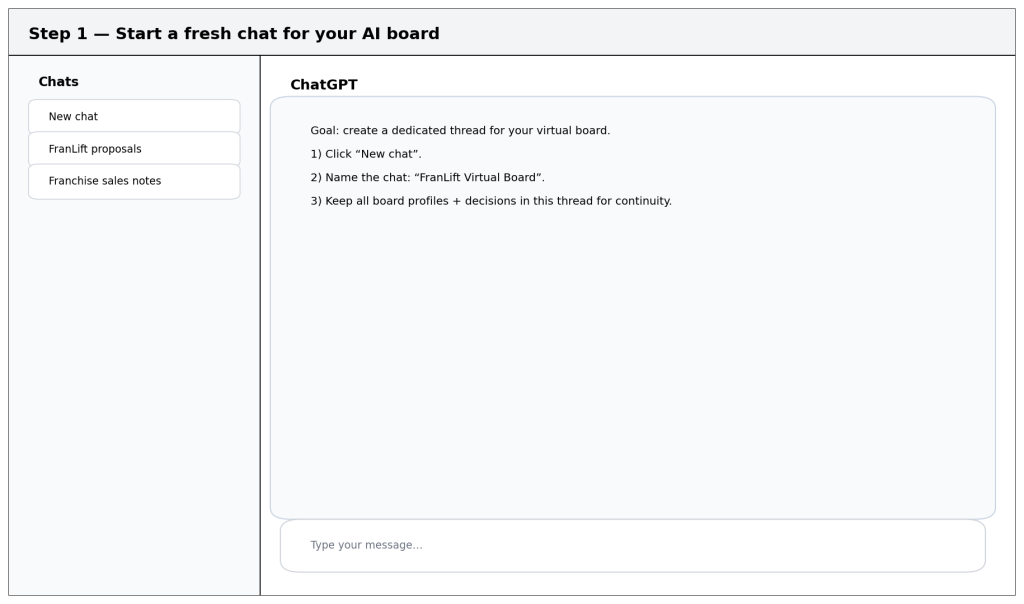
Step 1 — Start a dedicated board chat
Create one ChatGPT thread that becomes your board room. Keep your board work in that thread so it retains context and evolves as your strategy evolves.
Screenshot:
Step 2 — Create one advisor profile at a time (Deep Research prompt)
This is the foundation. You’re building “advisor profiles” so the board can respond consistently in their voice and frameworks.
Below is the prompt I started with. Use it for each one of your leaders, one-by-one.
Deep Research prompt (copy/paste the blue text below):
I want to build an AI board and use the profiles of several business luminaries to act as my advisors.
Deep Research request: Create a business-advisor profile of [INSERT NAME] as of today’s date. Research extensively this individual’s thinking frameworks, decision styles, risk approach, work ethic, and approach to communication.
Include the following sections:
Core mental models this leader uses, and how they apply them in real situations
Decision-making traits (urgency, risk appetite, tolerance for ambiguity, impulsivity vs patience)
Communication style (how they persuade, how they challenge, how they handle conflict)
Notable wins and what principles drove them
Notable failures/mistakes and what they learned or changed afterward
How this leader would advise me in 5 practical scenarios related to franchise sales for an emerging brand (fewer than 15 franchisees), including:
positioning & messaging
lead flow & demand generation
franchise development process design
validation strategy
improving close rates without compromising standards
Blind spots this leader would warn me about based on my situation
End with: “The questions this advisor would ask me before giving final guidance.”
Write it as a usable advisor profile I can reference repeatedly, with clear headings and practical takeaways.
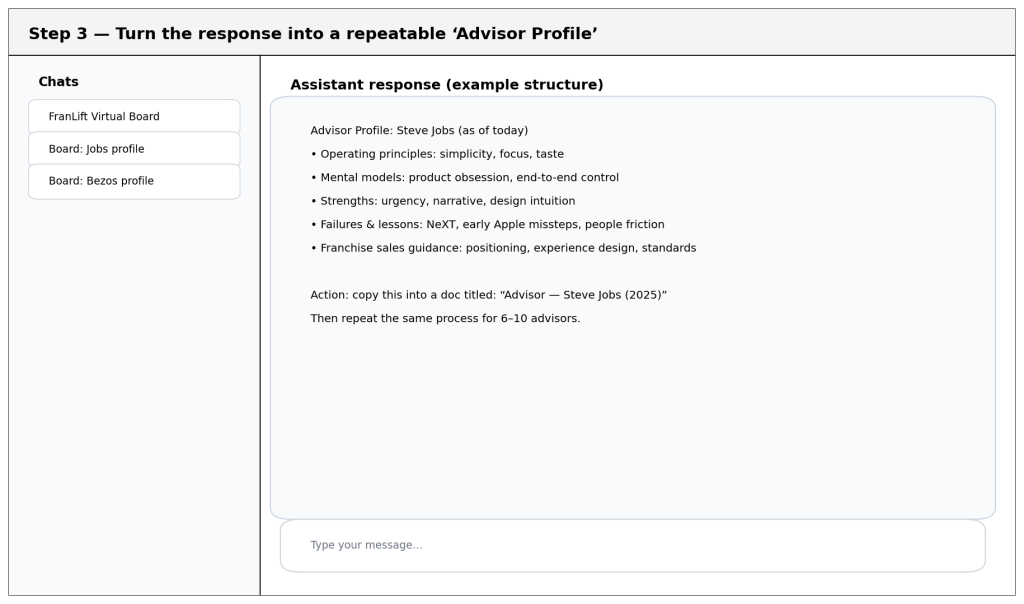
Step 3 — Save the advisor profile so it becomes reusable
When ChatGPT returns the profile, treat it like an “internal playbook page.”
What I do:
-
copy it into a doc named:
Advisor — [Name] -
keep them in one folder (Google Drive, Notion, Word—anything)
-
optionally paste back a short summary into the board thread like: “This is the active advisor profile”
Screenshot:
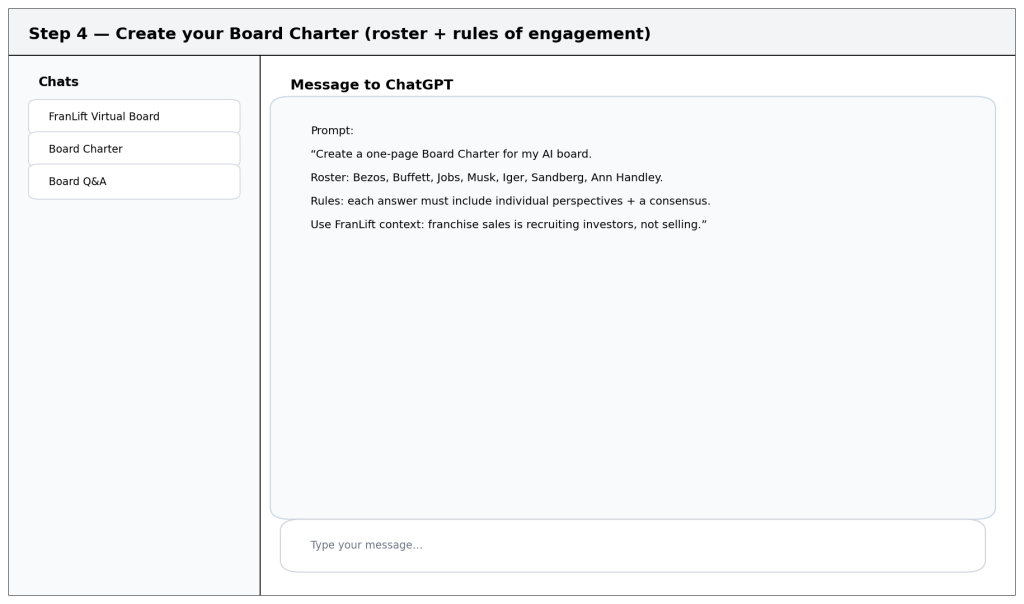
Step 4 — Create your Board Charter (roster + rules)
This is what turns a pile of profiles into a board.
Your charter should define:
-
who is on the board (6–10 people is plenty)
-
how you want answers delivered (round-table, then consensus)
-
what “good output” looks like (action steps, metrics, risks)
Screenshot:
step 4
Board Charter prompt (copy/paste):
Create a one-page Board Charter for my AI board.
Roster: [List your board members]
Operating rules:
Always answer with (1) round-table perspectives from each advisor and (2) a consensus plan
If you make assumptions, label them clearly
Provide practical next steps and 3–5 measurable metrics
Context: I run FranLift. Our work centers on franchise sales for emerging brands. I want board guidance that improves process quality, messaging, and decision-making.
Step 5 — Run a “board meeting” on anything, example: a franchise sales decision
Ask questions the way you’d ask a leadership team, with specifics and constraints.
Screenshot:
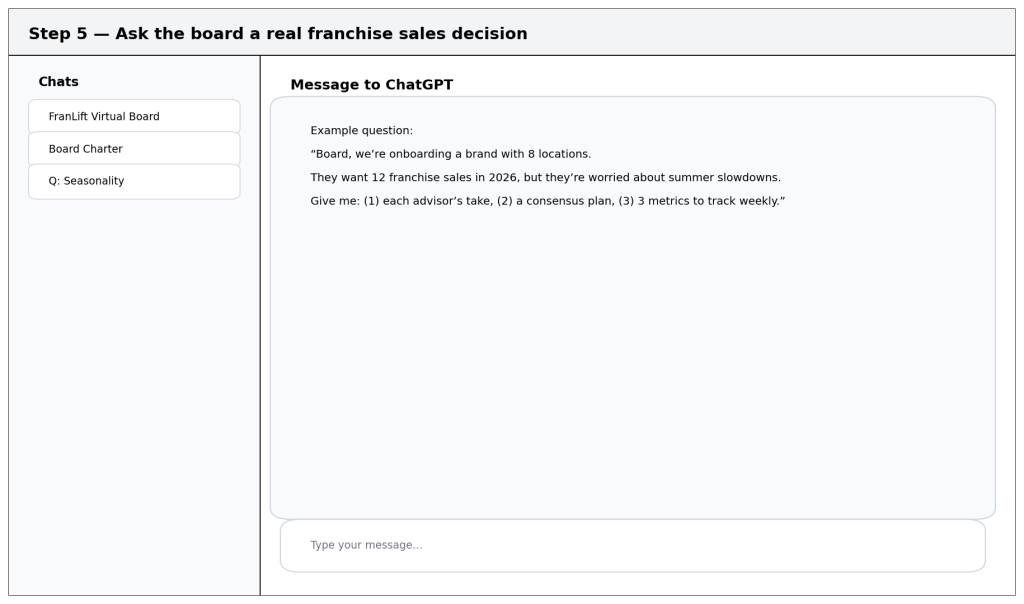
Board question template (copy/paste):
Board, here’s the situation:
Brand stage: [units open, years in business, emerging vs mature]
Goal: [franchise sales goal + timeline]
Current bottleneck: [lead flow / lead quality / process / close rate / validation]
Constraints: [budget, staffing, time, compliance, geography]
Give me:
Each advisor’s perspective
A consensus plan (step-by-step)
The top risks and how to reduce them
3–5 weekly metrics that tell us if we’re winning
Step 6 — Create a reusable weekly board agenda (so it becomes a habit)
This is where it gets powerful. You stop “randomly asking ChatGPT things” and start running a cadence.
Screenshot: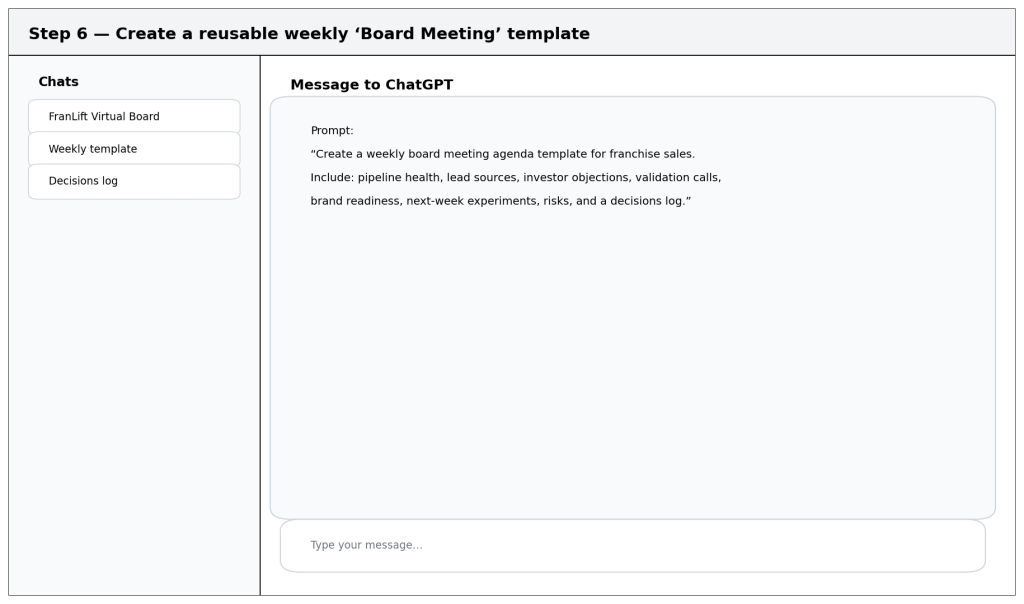
Weekly Board Meeting prompt (copy/paste):
Create a weekly board meeting agenda template focused on franchise sales.
Include:
pipeline health (stages + conversion)
lead sources and lead quality signals
investor objections and how to address them
validation and discovery call insights
readiness gaps inside the brand (support, training, ops)
next-week experiments (what we’ll test and why)
risks + mitigations
decisions log (decision, owner, due date, success metric)
A Final Thought From Me
I’ve been around franchising long enough to know that most problems in franchise sales don’t come from bad ideas or bad people. They usually come from moving too fast, not slowing down to pressure-test a decision, or surrounding yourself with voices that all think the same way.
When I started using ChatGPT as a virtual board, it wasn’t because I was looking for a shortcut or some shiny new tech. It was honestly about clarity. I wanted a way to challenge my own thinking, to sanity-check assumptions, and to look at decisions through lenses that weren’t just my own.
For the cost of ChatGPT, I now have access to decades of thinking from business leaders I’ve admired for years. Not just the highlight reels, but the failures, the pivots, and the moments where they got it wrong and had to adjust. If I could have paid earlier in my career to sit in on those conversations, I would have done it without hesitation.
That’s why I believe so strongly in the idea of a virtual board. It’s not about replacing experience or instinct. It’s about sharpening both. It’s about slowing down just enough to make better decisions, especially when it comes to franchise sales, where the choices you make early on can impact a brand for years.
At FranLift, we think deeply about long-term fit. Franchise sales aren’t transactional. You’re not just filling territories, you’re shaping the future of a brand and the lives of the people who invest in it. Anything that helps you approach those decisions with more discipline and perspective is worth paying attention to.
If this approach resonates with you and you want to talk through how we think about franchise development, infrastructure, and sustainable growth, I’m always open to a conversation. But even if we never talk, I’d encourage you to build your board. You may find that your next decision becomes a lot clearer once you do.
— Mike Pollock
Founder, FranLift
